|
On Sale NOW
|
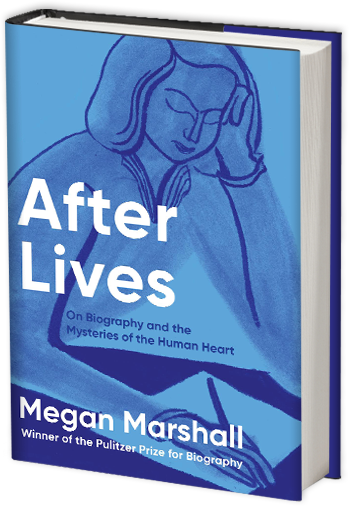
AFTER LIVES:
On Biography and
the Mysteries of the
Human Heart
By Megan Marshall
A moving and penetrating memoir of a life in biography from the Pulitzer Prize winner and “gifted storyteller”
(Judith Thurman, The New Yorker).
Megan Marshall’s innovative books, including The Peabody Sisters and the Pulitzer Prize–winning Margaret Fuller, are treasured works of American biography. In the richly absorbing essays of After Lives, Marshall turns her narrative gift to her own art, life, and the people in it.
In each of six essays, Marshall reinvents the personal essay form, as a portal to the past and its lessons for living into the future. The book’s brilliant, assured interplay between memoir and biography places surprising characters on the page, including the twelfth-century Buddhist hermit Kamo no Chomei, a reassuring spiritual presence for Marshall during several otherwise deracinating months in Kyoto. In her stunning coming-of-age tale, “Free for a While,” set in 1970s California, Marshall interweaves the story of her adolescence with that of Black Power martyr Jonathan Jackson, the author’s AP history classmate, gunned down at seventeen in a failed attempt to free his famed older brother George from prison in the case that put Angela Davis on the FBI’s Most Wanted list.
Here too is the author’s passion for the biographical chase, and for the mysteries at its heart. She tells the astonishing story of viewing the disinterred remains of her one-time subject Sophia Peabody Hawthorne, wife of Nathaniel, and their daughter Una, the truths of whose early death Marshall works to reveal.
Throughout these finely wrought essays, Marshall, “[at] the front rank of American biographers” (Dwight Garner, New York Times), makes palpable her driving impulse to “learn what I could from others: how to live, how not to live, what it means to live.”
PRAISE & REVIEWS
“What makes this book special is the way it shows how history lives in the present, clinging to the things we leave behind and in the stories we tell about them…. [After Lives] will stay with me.”—Louisa Thomas, New Yorker
"Imagine Nancy Drew with a Phi Beta Kappa key and you’ll glimpse the phenomenon of Megan Marshall, who many cite as the patron saint of biographers….Each of the essays in this miniature memoir explores portals to the past with lessons on pursuing the future, and the most significant lesson is to never stop searching, never stop asking questions, which Marshall does throughout her pages.”—Kitty Kelley, Washington Independent Review of Books
"Pulitzer Prize–winning biographer Marshall (Margaret Fuller; The Peabody Sisters) offers a memoir in essays, reflecting on how writing about others has changed how she sees her own experiences, relationships, and history. The six essays cover a wide range of topics, including Marshall’s thoughts on viewing the remains of Sophia Peabody Hawthorne (wife of Nathaniel) and their daughter Una; the three months that she spent living and studying in Kyoto; and her account of Jonathan Jackson, a 17-year-old classmate who was killed in a headline-making shootout in 1970. Throughout these essays, Marshall uses her biographer’s tools—interviewing witnesses, examining documents, checking memories against facts, and contending with separation from one’s subjects. What is gleaned from the assembled leavings is a form of truth, getting to a person’s core—in this case, the core of Marshall herself. The author’s completed narrative is intriguing and unexpected, peppered with insights, and full of meaning. VERDICT: An introspective examination of the biographer’s craft that interrogates how Marshall’s vocation has shaped her memories of the past. A writer’s memoir for those who enjoyed Colm Tóibín’s A Guest at the Feast."
–Library Journal
“Marshall ponders, with fresh urgency, the question…how to survive in this “husk of a world.” As it turns out, for the veteran biographer there’s only one possible answer: to keep looking at how other people have done it.”
–Christoph Irmscher, Wall Street Journal
“An Esteemed Biographer Puts Her Own Life in the Spotlight,”
–New York Times review by Alexandra Jacobs
“Can learning about other people’s lives inform how we live our own? This question arose as I read, or rather inhaled, Megan Marshall’s memoir After Lives: On Biography and the Mysteries of the Human Heart.”
– Christian Science Monitor review by April Austin
“What a marvel this book is!” Larry Wilson’s Pasadena Star News column on After Lives
"In this slim volume of essays, Marshall, a Pulitzer Prize-winning biographer, turns inward, reflecting on her discovery of old personal paraphernalia, including letters and photographs. She writes of her grandfather, Joe Marshall, who oversaw photography and film for the American Expeditionary Forces during the First World War, and of Jonathan Jackson, a Black high-school classmate, who was killed at seventeen when he tried to free his older brother, a Black Power activist, from prison. The book also contains anecdotes about the death of her partner and revelations about her mother, a gifted painter who sacrificed her art in order to help raise her family."–After Lives recommended in“Briefly Noted” column of The New Yorker’s 100th anniversary issue
Brendan (History Nerds United) gives AFTER LIVES five-star review on Goodreads!
"Celebrated biographer Marshall devoted decades to the lives of the Peabody sisters, Margaret Fuller, and Elizabeth Bishop, researching and writing with skill, innovation, and an abiding mission to illuminate women’s lives. She now considers her own experiences in fluent and involving essays. Marshall ponders individuals who continue to call to her, including Una, the troubled firstborn child of Nathaniel and Sophia Peabody Hawthorne. She delves into her high school years in racially discriminatory Pasadena, and remembers an activist classmate, Jonathan Jackson, who was killed during a daring effort to free his incarcerated older brother, George, one of the Soledad Brothers, in the case that embroiled Angela Davis. An old ice pick inspires an inquiry into an obsolete industry, her father’s mental illness, and her artist mother’s sacrifices. She looks back at an autumn in Kyoto, the loss of her partner, and the isolation of COVID-19. Throughout, Marshall nimbly extrapolates significant implications from small moments, humble objects, and quiet discoveries as she astutely and gracefully records a “season of introspection,” ending with a stirring and promising account of how she found herself "practicing biography again."
—Booklist
"Much-lauded biographer Megan Marshall (she’s written about the Peabody Sisters, Margaret Fuller, and Elizabeth Bishop) opens up her own life to readers in “After Lives: On Biographies and the Mysteries of the Human Heart.” Interweaving stories from her own life, Marshall looks back on her work and her endlessly fascinating subjects."
–Kate Tuttle, The Boston Globe
“Six essays that offer intimate reflections on [the author’s] life and work…candid, sensitive recollections.”
—Kirkus Reviews
“Megan Marshall . . . spent her life uncovering the lives of others, penning major biographies, including Elizabeth Bishop: A Miracle for Breakfast (Mariner Books, 2017) and her Pulitzer Prize–winning Margaret Fuller: A New American Life (HarperCollins, 2013). When you spend so long with a subject, you might expect to be done when you are done, but not so. In the aftermath of her monumental efforts, Marshall found ‘the loose ends of the full-scale narratives I’d researched teased my imagination.’ What’s more, she had her own stories to tell, she reports, thanks to ‘documents of my own history, piled up in the closets over the years.’ After Lives is the end result: six long essays that begin with a piece sparked by a mystery concerning Una Hawthorne, the oldest daughter of Nathaniel Hawthorne and Sophia Peabody, one of the three Peabody sisters who is the focus of an additional Marshall biography.
When Sophia and Una’s remains were sent from England back to the States, Marshall was invited for a viewing. She describes uneasily inspecting a small coffin with tissue paper, some bones, a bonnet, and gray and auburn heads of hair—the latter a surprise, as Una’s auburn hair had turned white before her death, according to her brother, who was at her side when she died. Had he lied? Might one lie hide another? Marshall explores.
In a different essay, Marshall investigates a box of family letters and photographs from her grandfather’s vibrant years in Paris during World War I. In another, she considers our attachment to useless items, starting with a wood-handled icepick that Marshall keeps in her kitchen. One of the collection’s most affecting pieces concerns the death of a high school classmate, a 17-year-old boy who tried unsuccessfully to rescue his older brother from prison. Marshall situates his story amid reflections on race relations in her childhood hometown.
Although the essays can be read independently, they return to aspects of Marshall’s life and are interwoven with a larger sense of lives not lived, either because they were cut short or simply not experienced as fully as they might have been due to mental illness, financial need, or other circumstances. Marshall suggests how the strong and sometimes stifled women in her own life drew her to document the lives of successful women as well as of those who lived in the shadow of better-known figures. Meanwhile the recent loss of her own partner makes her curious about Kamo no Chōmei, the ‘Thoreau of Japan,’ whom Marshall learns about while on a fellowship in Kyoto. Long after Marshall has left Japan, his delicate questions resonate with Marshall as she walks the street of a New England town and grieves the death of her partner: ‘Where should we live? / And how? // Where to find / a place to rest a while? // And how bring / even short-lived peace / to our hearts?’”–Debra Spark, Radcliffe Magazine
"The Pulitzer Prize-winning biographer of Margaret Fuller . . . here looks at herself and her work in a series of essays. One would not have expected, from her book subjects, that she would have first-hand material about her high school classmate Jonathan Jackson, shot down at age 17 while attempting to free his sibling, George (Soledad Brother), from prison—the sort of shocking turns lives, including her own, can take."
–Harvard Magazine
“We are all biographers from childhood,” Marshall concludes her book. “Life is short, the ancient doctor Hippocrates warned, and art is long; the pursuit of a craft, and the lasting creation itself. So, too, is the art we make of lives.”
–California Review of Books
“Megan Marshall has written a powerful and haunting book about memory, family, friendship, and history. In these intricately braided essays, Marshall approaches her own life through the lives of others as she revisits her grandfather’s experience in World War I, a school friend’s tragic death, a stay in Kyoto, and a 19th-century biographical mystery. After Lives is an intimate and illuminating chronicle of the self from one of America’s best biographers.”—Heather Clark, author of Red Comet: The Short Life and Blazing Art of Sylvia Plath
“In her elegant reflections on the biographer's craft, Megan Marshall has in fact given us a memoir--one that enables us to look afresh at books and lives and the way they shape one another.”—Drew Gilpin Faust, author of Necessary Trouble: Growing Up at Midcentury.
“Megan Marshall has done it again. This time, her gentle, probing eye, her compassion and generosity, are turned inward. In moving and subtle prose, she explores her own canyons of grief, the origins of her interest in the lives of others, and vastly, beautifully, in the making of art itself.”—Ayana Mathis, author of The Unsettled and The Twelve Tribes of Hattie
“Megan Marshall’s rich and moving essays, both fresh fieldwork and second takes from an illustrious career in biography, ask searching questions of this most fascinating genre. With its tantalizing glimpses of the author at work, After Lives reveals the alchemy of life writing.”—Francesca Wade, author of Square Haunting: Five Writers in London Between the Wars
“Grave and profound, clear-eyed and informative, these essays invite us into the biographer’s workshop and into the mind of one of the genre’s most accomplished practitioners.”—Anthony Walton, author of The End of Respectability: Notes of a Black American Reckoning with His Life and His Nation
|
